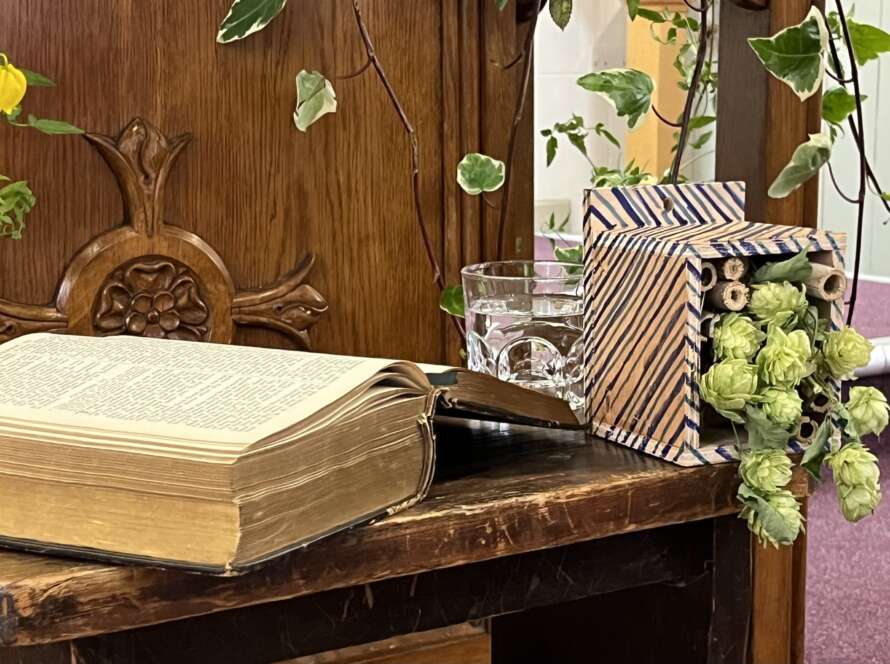
Laura Chapman took on the challenge set by Rev Jenny at the start of 2025 to read the whole bible cover to cover in just one year. In this reflection they cover a vengeful God, women in the bible, and a summer without Jesus.
In January 2025 I made just one resolution for the year ahead: to read the whole Bible. It was Jenny who inspired me to do this. She’s not only been doing this herself every year for the last 17 years, but also has an infectious enthusiasm for bringing people along on that journey with her.
Like any Christian, I felt that I was familiar with quite a lot of the Bible. But what proportion of it had I actually read? I must have heard or read some passages tens or even hundreds of times, but what about the bits that are rarely included in services or studied in house groups?
If I am completely honest about what it was that most encouraged me to read the Bible in a year, it was when Jenny told me that if I did it, I would not be the same person – or the same Christian – again. I love a challenge, and I was genuinely curious about what this might mean for me. Well, I can’t say I wasn’t warned.
But first, some practicalities. Everyone has a sense of how big the Bible is as a physical object, but how long does it take to read? When I finished the first instalment on Audible on 1 January last year, the app announced that I had 86 hours and 26 minutes left. That’s over three and a half solid days of listening! Of course, I didn’t listen to it all in one go. The version I had, which is read by David Suchet, helpfully breaks the Bible into 365 chunks of about 11 to 16 minutes each. Each daily instalment starts with some verses of a Psalm or a Proverb, before continuing with a New Testament reading and then an Old Testament one.
If you choose to take on this challenge, you may prefer to read the Bible rather than listening to it. One day I hope I’ll do that too. But last year I knew that I stood more chance of completing my goal if I found a way of reading the Bible that slotted easily into my daily life. I did a large proportion of my listening either washing up or having a bath.
So, what was it like?
First, the bad news. If you listen to the Bible in a year, it is hard not to form the impression that God is a coercive, vengeful tyrant. I chose for today’s order of service an image of the rainbow in Genesis 9. It seemed fitting for a Covenant Service – that symbol of God’s promise never again to destroy his creation. Everyone learns that story at Sunday School. But if you read the Old Testament, that’s not the end of it. Time and again, God tells people how angry he is with them, how they have let him down, how he is going to completely destroy them.
Quite often, my partner – who is not a Christian – would come into the room while I was listening and it seemed that she would always enter just when God was at his most vengeful. I didn’t want her to get a bad impression of the Bible, so I would apologise and say, ‘It’s not all like that.’ But the trouble is, so much of it is just like that. What felt at first like an unfortunate coincidence was quite simply the law of averages. Why, I thought, would anyone become a Christian based on this? Why would anyone remain a Christian?
Secondly, what the Bible has to say about women is even worse than I expected. In particular, the experience of hearing so many litanies of male names, where one male writer or another feels the need to tell us who was the son of who, through tens of generations, underscored for me the wilful erasure of each of the women who mothered these men, as well as their invisible sisters. And I was also shocked to discover how frequently, when conveying the waywardness of a particular community in turning away from God, a male writer would reach for the metaphor of a woman who had betrayed her husband. And the metaphor was never – not once in the whole Bible – presented the other way around, with a disloyal husband betraying his wife.
What did this have to say to me? Why should I respect a text which either presented me as being utterly irrelevant, or as being a contemptible provoker of male temptation?
The bible changes you
Jenny was right. I couldn’t be the same Christian having heard all of this. And sometimes I wasn’t sure I could still be a Christian at all.
I felt like someone who had been made party to a terrible secret. And I looked at fellow Christians with new eyes. How many of them had read the whole Bible? Who else knew what I knew? I realised that, just like me, most people haven’t read the whole thing. But what about those who have? How did they carry on being Christians?
But I kept remembering something I had heard years ago, when I was trying to make sense of whether I could be both gay and a Christian. This person used the phrase ‘taking the Bible seriously’, as a counter to those who boast of ‘taking the Bible literally’. Those of us at Open Table who have been on a similar journey will be all too familiar with the six so-called ‘clobber passages’ of scripture which seem to condemn homosexuality. How heavily those passages have clobbered so many of us. Several of us here bear the scars of people quoting those verses at us, or of poring over them secretly ourselves, trying to make sense of what they might be saying about us.
I found that phrase ‘taking the Bible seriously’ so transformative when I first heard it in my 20s. It helped me to set those six passages in their context, and therefore to put them in their place. Taking the Bible seriously meant understanding that each book was written at a very particular time and for a particular purpose, and that serious reading of the Bible needed both to take account of that context and to discern what it might then be saying to us now. I could no longer be clobbered by verses that were speaking about practices that bore no relation to the sort of loving, stable relationship that I sought – and that I, unlike any of the women in the Bible, had the freedom to seek.
I think, now, when I look at the people I know who have read the whole Bible and are still Christians, that I have a much fuller appreciation of what ‘taking the Bible seriously’ might mean. And I want these people to continue to guide me on that journey.
I also feel newly liberated now. Over 86 and a half hours of Bible, and just 6 clobber passages! God has far, far more to say about circumcision, menstruation, skin disease, sacrifices, clothing, food preparation, and – and I found this fascinating – colour schemes than he does about homosexuality. That’s worth knowing, next time somebody tries to clobber you about sex.
And as I asked myself whether I still wanted to commit to a religion whose holy book is so full of violence, it struck me that perhaps 2025 was a grimly apt year to undertake this journey. Because as I listened to story after story of vengeance and genocide, I was repeatedly struck by the parallels with what I had just heard on the news. And the more I heard those parallels, the more I realised that these Bible passages were telling me much more about what people – men – wanted their God to be like, than about what God is like.
I started to see the Bible as a collection of lenses through which different people had tried to arrive at a sense of who God is and what God is like, and to see their quest to do so as being much like mine, like all of ours.
A big disadvantage of following the NIV schedule for reading the Bible in a year is that the Gospels are over by about the end of May. This meant that through the long weeks of summer and autumn, it was easy to lose sight of Jesus. But this was a helpful insight in itself. It brought my attention to what a small proportion of the Bible is taken up by the four Gospels. By comparison, the 39 books of the Old Testament felt like a thick forest of stories, rules and prophecies; the 23 other books of the New Testament like a library of sermons. One result of this is that I experienced Advent in a totally different way. The coming of Jesus as a human baby felt like a fragile miracle of light in the midst of all that. I have never felt so moved by an Advent service as I did this year, sitting in complete darkness at Great St Mary’s on 30th November, as the first candle was lit.
I can’t claim to fully understand what I was feeling that evening, or to be able to explain what it is that has changed for me. But it was something to do with all of these prophecies, and all of these stories, and all of these clumsy attempts to grasp at a sense of God suddenly falling away before the simplicity of a tiny, vulnerable human, so unlike what anyone had expected, and so full of light and hope and promise.
What’s in store for 2026?
The New Year is well underway now, and I’m not repeating the cycle of the Bible in a year. Not yet. I’m listening to ‘The Tenant of Wildfell Hall’, by Anne Bronte. But I am returning to the Gospels, and I’m doing so with fresh eyes. I find that, more than anything, I want to go back to the life of Jesus, to the things he did, the what he said, to the relationships he formed with those around him. To how he’s somehow at the centre of it all, cutting through all the fury and the confusion and the insecurity, calling me to follow.